
Introducing LILAS4SOILS Farmer Network
LILAS4SOILS is built around a Living Labs approach that brings farmers, researchers, and stakeholders together to co-create and test Carbon Farming Practices (CFPs) for healthier, more resilient European soils.
To make this possible, LILAS4SOILS selected 100 demo-sites, of which 85 are commercial farms across six countries: Spain, Portugal, France, Greece, Italy, and Israel. Within five Living Labs, these farmers are collaboratively testing and validating 20 different CFPs, covering agroforestry, nutrient and soil organic carbon (SOC) management, livestock systems, and peatland management.
The result is a rich and diverse farm network that spans multiple land uses, farming systems, soil types, and pedoclimatic zones, making LILAS4SOILS a true Southern Europe laboratory for Carbon Farming in action.
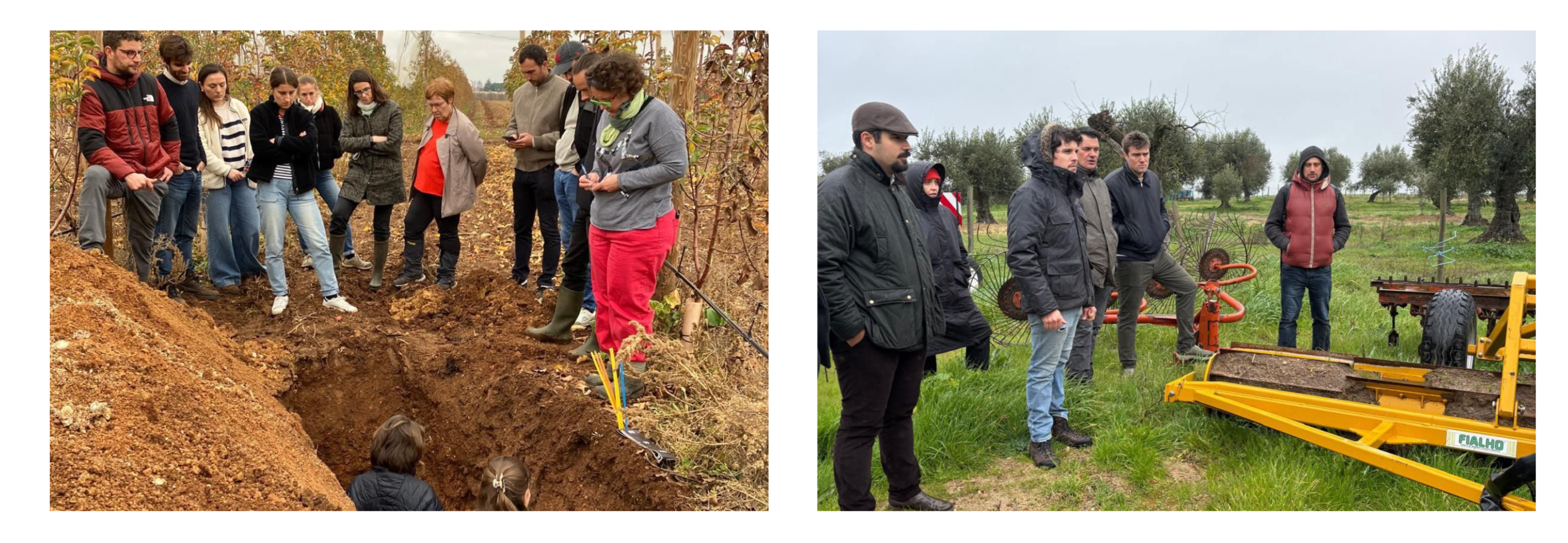
A Diverse Portfolio of Farming Operations
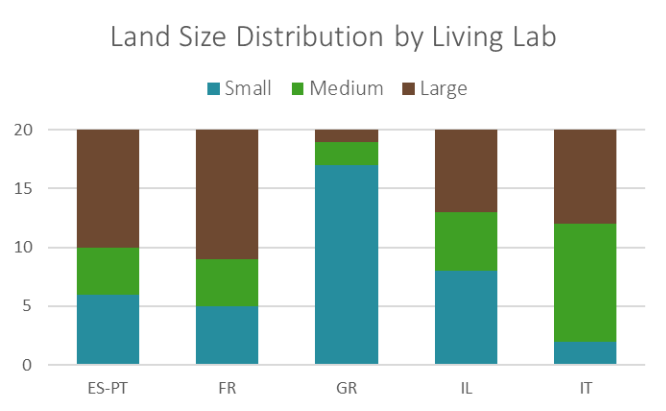
The LILAS4SOILS farmer network reflects the real diversity of European agriculture, as it includes:
38 small farms (≤ 20 ha)
25 medium-sized farms (21–99 ha)
37 large farms (≥ 100 ha)
This range is not accidental, as the project focused on testing CFPs across different operational scales, economic realities, and management styles. This is essential to assess not only environmental impacts, but also the practical and financial viability of Carbon Farming at farm level.
During our project 1st year a few national differences are particularly revealing:
- Greece has the smallest average farm size at 15 hectares, reflecting traditional Mediterranean farming structures.
- Portugal stands out with an average of 330 hectares, dominated by extensive farming systems.
- Italy shows the most balanced distribution across all farm sizes, making it a valuable ground for scale-specific insights and for understanding scale-specific effects.
Across the network, most farmers already use fertilization (79 farms) and irrigation (64 farms), highlighting the importance of integrating CFPs into existing management systems rather than replacing them entirely.

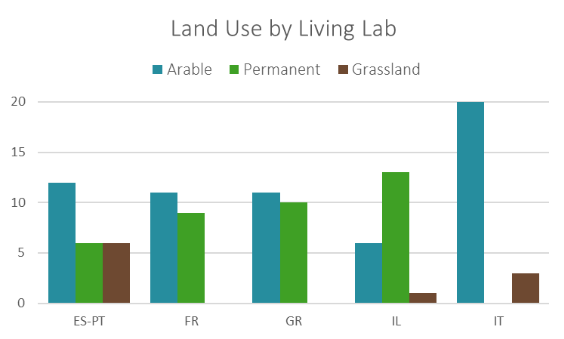
Regional Specialization: From Cereals to Olives
Land use patterns illustrate regional differences, as arable land dominates overall (60 farms), followed by permanent crops (38 farms) and grassland (10 farms).
Italy focuses heavily on intensive arable crops such as maize, soybean, wheat, and rice. In contrast, Portugal, Greece, and Israel concentrate more on tree crops, particularly olives and fruit trees.
Spain and France lead in cereal production, while also cultivating legumes, vineyards, and maintaining permanent grasslands. Livestock is present on 29 farms, except in Greece, where it is not represented in the network.
Portugal deserves special mention for its highly diverse land use portfolio, which includes significant grassland areas alongside arable and permanent crops, offering valuable insights into mixed systems.
Carbon Farming Practices: Already Underway
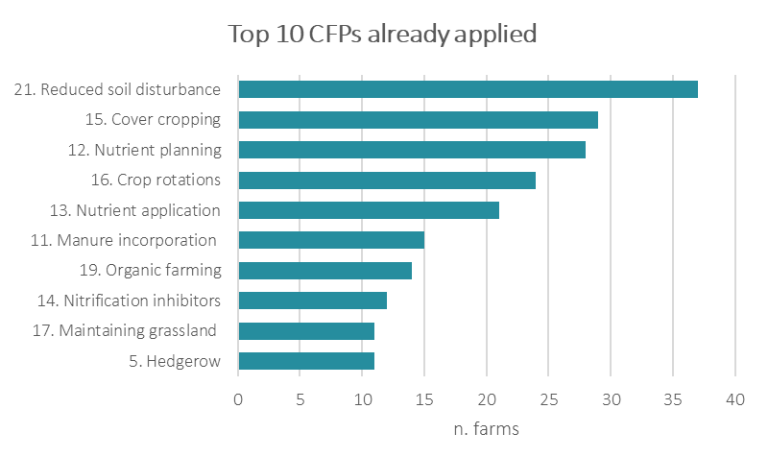
One of the most striking findings of LILAS4SOILS is that most participating farmers were already implementing some form of Carbon Farming Practice before joining the project.
The most commonly adopted practices include:
- Reduced soil disturbance (37 farmers)
- Cover cropping (29 farmers)
- Nutrient planning (28 farmers)
- Crop rotations (24 farmers)
This widespread pre-existing adoption of sustainable practices has shaped how LILAS4SOILS defines control plots and baseline measurements progress throughout the project.
France, Italy, and Portugal show the highest overall adoption rates, particularly in nutrient management and soil organic carbon strategies, two pillars of climate-smart agriculture.
However, the LILAS4SOILS team has noticed that gaps remain, namely, Peatland management practices are under-represented due to the limited presence of peatlands in the participating regions. Similarly, livestock-related practices require deeper analysis and more precise categorization to fully understand their direct impact on soil health.
Preparing the transition
At the heart of LILAS4SOILS is co-creation. The Living Lab teams are working hand-in-hand with farmers to assess current practices, identify opportunities, and design tailored transition pathways towards more effective CFPs. Throughout the project, these practices will be continuously monitored to evaluate their impact on soil health and carbon sequestration.
In early 2026, LILAS4SOILS launched a second round of co-creation workshops across all Living Labs locations, where farmers will share their experiences, challenges, successes, and innovative solutions they have developed on their own farms.
The extraordinary diversity of farming systems and experiences within LILAS4SOILS represents a powerful knowledge base not only for the project itself, but for farmers, policymakers, and stakeholders across Europe and the Mediterranean seeking to understand how Carbon Farming can work in practice and to create a more sustainable future for European Food Systems.
Article Revised by: Paula Roque Esteves, LILAS4SOILS Communications & Dissemination WP Lead and BGI Communications Director.

Funded by the European Union (Grant no. 101157414). Views and opinions expressed are however those of the author(s) only and do not necessarily reflect those of the European Union, European Research Executive Agency (REA). Neither the European Union nor any other granting authority can be held responsible for them.

