
Arribes Del Duero: Resistence Vineyarding at The Border
The area known as Arribes del Duero, is in the Spanish Autonomous Community of Castilla y León, stretching along the border with Portugal, where the Duero River gets into deep canyons surrounded by awe-inspiring granitic cliffs. In this area, soils are stony, shallow and infertile, and have a low water retention capacity. The climate is characterized by a wet and mild period from mid-autumn to mid-spring, and hot and dry summers, in which the number and intensity of heat waves have dramatically increased over the last few decades because of the climate crisis.
These are not the best conditions for the practice of agriculture, but terraced vineyards, delimited by old stone walls historically developed in this region and are still one of its most remarkable features. Nonetheless, most of these vineyards were developed in narrow terraces, which makes mechanization of agricultural labour very difficult, and maintenance of terraces and stone walls is very time consuming. Thus, despite the distinct flavour and increasing recognition of the wines produced at Arribes del Duero, most vineyards are low profitable and have been progressively abandoned and colonized by the shrubs and woodlands.
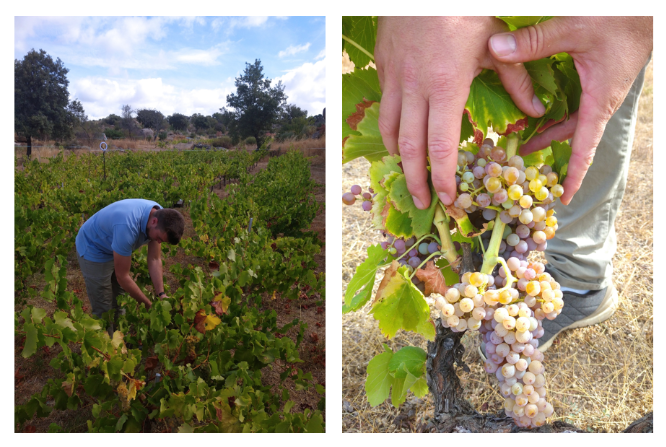
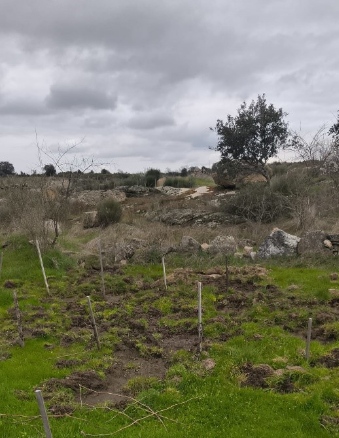
But in 2017, Ángel García, a young agricultural engineer at that time living in Barcelona, use its savings to acquire a few small (≈ 1 ha) vineyard estates close to the village of San Felices de los Gallegos. One of these vineyards, named La Lobaguera, was used by an amateur farmer for self-consumption and comprises two terraces; an upper one in which the vines were almost lost, and a lower one with very old vines belonging to an astonishing range of traditional varieties of grapes, including red ones such as Tempranillo, Garnacha, Juan García, Bruñal and Mandón and white ones such as Doña Blanca and Puesta en Cruz. Ángel also planted a vineyard of the Puesta en Cruz variety in the upper terrace in 2020.
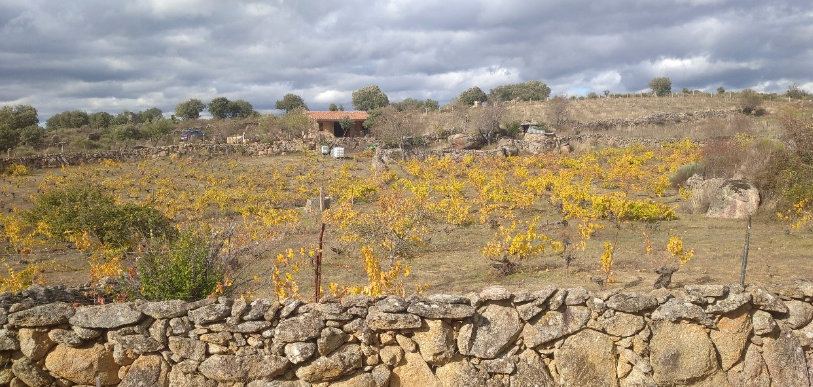
From 2020 onwards, he started to manage both vineyards in a different way, practising no-till, allowing the development of a green cover of spontaneous herbaceous vegetation in the inter-row paths, and applying an organic amendment every two years. He started to use foliar biofertilizers, and stopped using pesticides, but used sulphur and copper as plant protection systems. In fact, La Lobaguera was recently certified as an organic agriculture exploitation.
Because of the practices, Ángel perceives soil organic carbon and nitrogen content and soil health in general have increased over the last few years. Through involving both (old and new vineyards) in the LILAS4SOILS project as part of the IBERSOILL Living Lab, he would like to check if such increase had occurred and to improve carbon farming practices. Specifically, he would like to incorporate the residues of vineyard’s pruning into the soil, and sow a green cover consisting of a mixture of two gramineous plants, Vulpia sp. and Bromus hordeaceus, in the old vineyard, where the spontaneous cover has not developed in a satisfactory way, to use a different fertiliser for the organic amendments.
As both vineyards are surrounded by Mediterranean old-growth forests and woodlands, developed in abandoned agricultural lands, controlling the spontaneous colonization of vegetation is a recurrent problem. For this reason and to increase water retention, Ángel is also thinking on conducting organic or inorganic mulching in the lines.
As major administrative or legal constraints to develop his activity, Ángel mentions the large costs overruns that the aforementioned difficulties give to his product and suggests that institutions should give financial support to develop dissemination campaigns focused on increasing the degree of awareness of consumers with regard to the added value of traditional agriculture. Finally, Arribes del Duero was declared a Natural Park in 2002 and wild animals such as birds, wild boars, and martens, are very abundant in the area and often feed in terraced vineyards such as those of Ángel, provoking an additional damage to their production.

Funded by the European Union (Grant no. 101157414). Views and opinions expressed are however those of the author(s) only and do not necessarily reflect those of the European Union, European Research Executive Agency (REA). Neither the European Union nor any other granting authority can be held responsible for them.

