
Las Cortas De Blas: Carbon and Educational Farming in The Castilian Páramos
The Duero basin, in the Autonomous Community of Castilla y León (Central-North Spain), is crossed by several ranges of plateaus, whose mean altitude is approximately 100-150 m higher than the surrounding plain. These plateaus, locally known as páramos are formed by Jurassic (Terra Rossa) limestones, and therefore, their soil is also stonier and less productive for agriculture. However, these areas retain more autumn and winter fog and are also wetter, harbouring fragments of holm- and Portuguese oak (Quercus ilex and Q. faginea) mixed forests. The paramos are also very appropriate for the development of agricultural systems integrating livestock (mainly sheep) on cropland management.
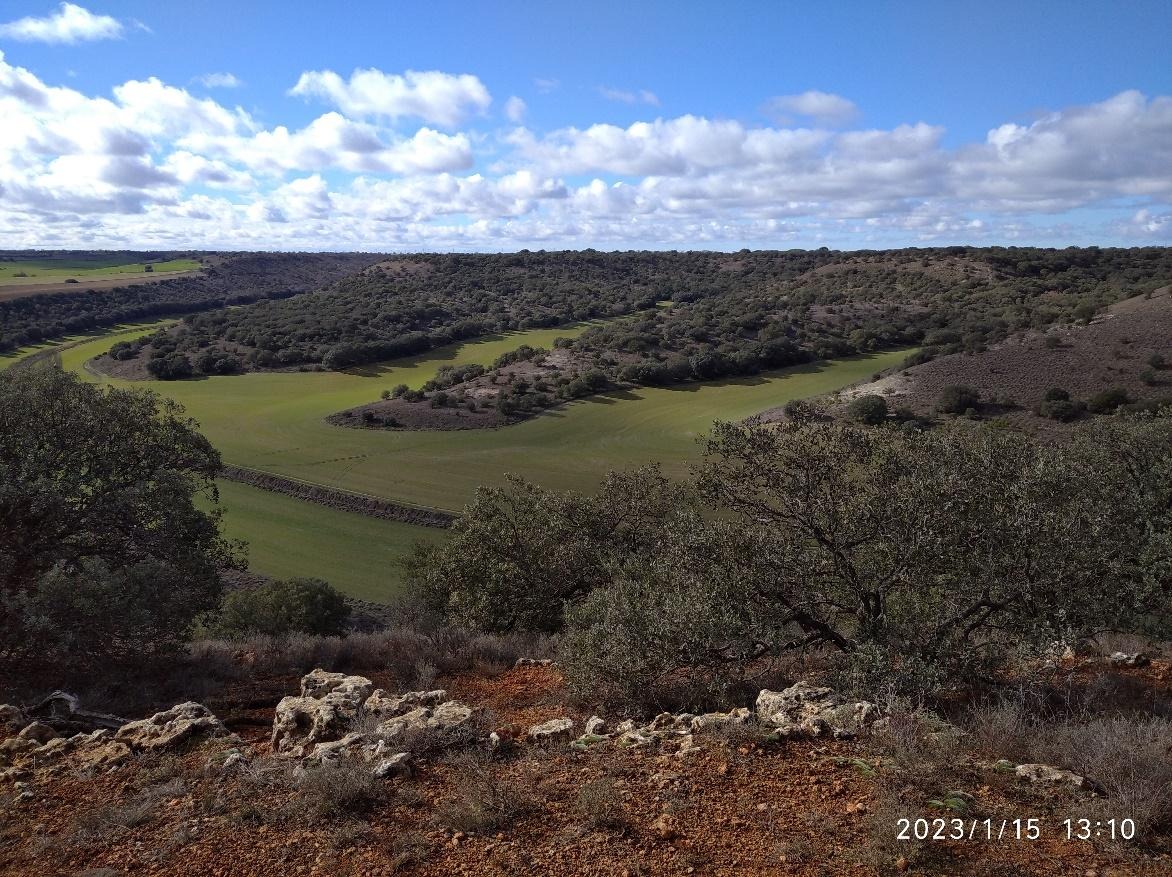
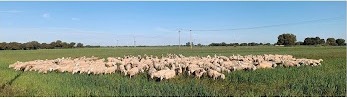
This is the case of Las Cortas de Blas, a familiar milk livestock farm in the North of Valladolid province which, since 2002, had been transformed by its owners, Ricardo and Pady Miranda, from conventional to organic farming, becoming a local reference and participating in several agricultural research projects such as PAS-AGRO-PAS (PRIMA 2020; PCI2023-143417). They had developed an integrated crop-livestock system aiming to reduce the dependence on feed exports as well as greenhouse gases (GHG) emissions of the farm. Las Cortas as it is known by locals, accounts for more than 700 dairy sheep on a semi-extensive regime, through which the animals feed partially on the stable, partially on forage crops cultivated in the exploitation as part of carefully developed crop rotations. Ricardo and Pady also mown and pack all those plants that have not been consumed by the animals in early summer. In all estates of their exploitation the soils are managed through minimum tillage, with just one chisel pass.
Since 2005 and 2017, respectively, Las Cortas de Blas, that has been certified as an organic agriculture exploitation, also includes an educational farm to which scholars from the surrounding villages and the Valladolid metropolitan area go to summer camps, and an artisan cheese factory that produces for several shops and supermarkets.
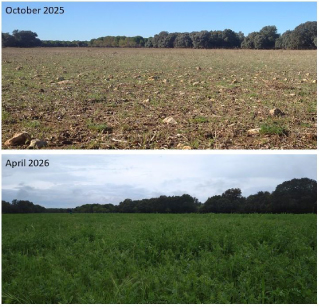
Through participating in the LILAS4SOILS project as part of the IBERSOILL Living Lab, Ricardo and Pady aim to better improve the aforementioned crop rotations. To attain this objective, he will use an estate in which the soil was ploughed with turning for the last time in autumn 2018. Then, they had cultivated rainfed alfalfa over five years, leaving the rustic sheep herd to feed on such crop, in late spring, yearly. In autumn 2023 they ploughed the soil again but passing a chisel plough tiller, which reaches less depth. Afterwards, they have sown ray-grass and triticale, being both crops consumed by the sheep herd. The last time Ricardo and Pady added manure to the soil of such estate was also in autumn 2018, since then, they had just used the sheep droppings as minimum fertilization strategy.
In such estate, in October 2025 Ricardo and Pady sowed a mixture of vetch and oats in 2025, which has been successfully developed. In 2026 they will sow annual ray-grass, and in 2027, triticale. The same rotation will start again in October 2028. Each year, in May, they will drive the field sheep herd to feed on such crops. In early July, they will mow and pack all non-consumed plants. In September, they will drive again the herd through the state in order to consume all these plants that have resprout. Both farmers expect that all these practices will increase the soil organic carbon and health even more.
For the next few years Ricardo and Pady aim to mechanize the feeding of sheep on stable to reduce production and labour costs. They perceive certain difficulties related to the low market prices of the milk in the market as well as in obtaining funds to implement new projects, but no major administrative or legal constraints to develop his activity. In spite of these few dark clouds on the horizon, the farmers fell themselves satisfied with the project they have built, that receives a strong social support all over the area, and point at the opportunities given by local networks and market demand to distribute their products.

Funded by the European Union (Grant no. 101157414). Views and opinions expressed are however those of the author(s) only and do not necessarily reflect those of the European Union, European Research Executive Agency (REA). Neither the European Union nor any other granting authority can be held responsible for them.

